

Harold Tibbs/Toby I
by Marianne Love
Reprinted from the 1998 International Colored Appaloosa Assoc. Newsletter
Old-time Appaloosa owner Harold Tibbs has never strayed too far from home. He once resided in California while working for a logging company, and he spent a few months in a Chicago hospital being treated for complications from a broken leg. During the late 1930s, he lived in Montana’s Madison Valley riding 40,000 acres of range as a ranch hand.

Most of his 82 years, however, have been spent in North Idaho. He grew up in Bonners Ferry (about 30 miles south of the Canadian border) where his parents were school teachers.
Most of his adult life he’s lived in Sandpoint, a resort town 30 miles south of Bonners Ferry. As a retired water filter operator for the City of Sandpoint, Tibbs enjoys puttering with machinery or attending to various maintenance needs on his 30-acre Tibbs Arabian farm north of Sandpoint where he lives with his wife Virginia, a Western artist. Of their six kids, two daughters, Barbara and Laurie—both school teachers—also live on the farm where they train Arabians and teach general horsemanship in the indoor arena.
Tibbs’ two daughters and his stepdaughter, all of Sandpoint, Idaho, have all participated in the horse world in a variety of ways: teaching, announcing, judging, competing, trail riding, and equine writing.
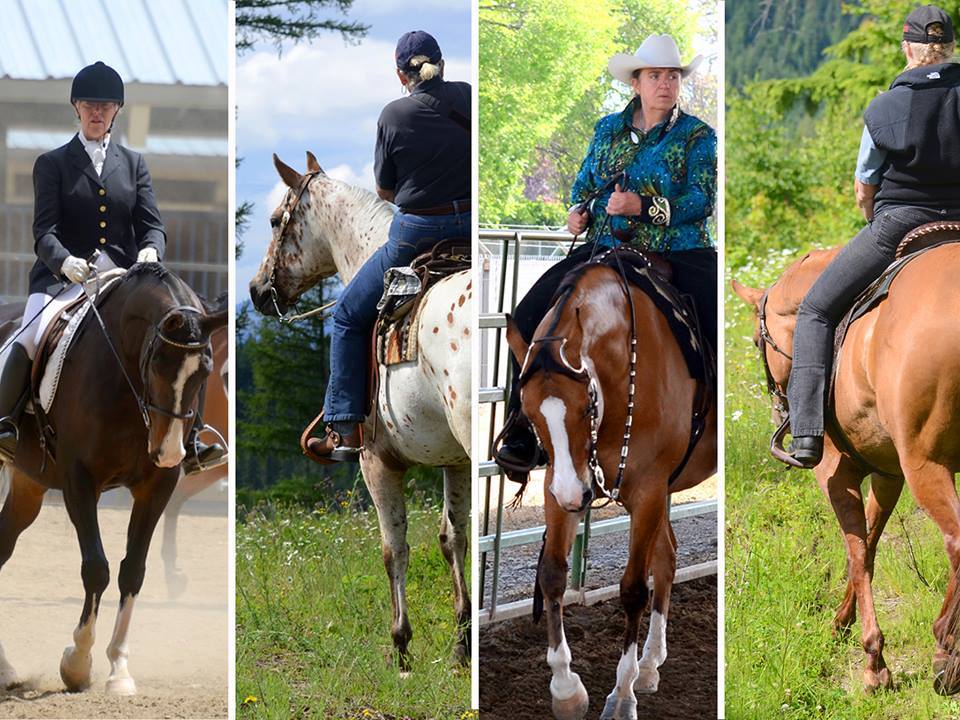
In this photo, Laurie Tibbs is pictured on the black bay and dun Half Arabians, Marianne Love rides Appaloosa mare Easy Dream Design while Barbara Tibbs competes on her buckskin Half Arabian.
Tibbs may not have strayed too far from rural North Idaho, but his influence with old-time Appaloosas spans the world. In fact, last fall he received a sample registration form from the Appaloosa Horse Club of South Africa. Smack dab in the middle of the document was a cut-out of Harold riding his beloved Toby 1 in the first-ever National Appaloosa Show at Lewiston, Idaho Tibbs and Toby cleaned up at the show, winning three national classes and taking second in another. Ardis Racicot, a friend (who later owned the stallion after Tibbs gave him to her), rode Toby in Women’s Pleasure. When the day had ended, Toby (F-203) had won the performance championship. Prizes included a silver belt buckle, which went to Racicot, a Tibbs thinks that Toby’s “star” qualities gave him an edge. “I felt like I had the best horse there,” he recalled. “Toby was a horse of good saddle and stock type. He would weigh around 1,100 pounds and stood about 15.1 hands. His head wasn’t too refined, but it was still a smart head,” he added. “He was a horse that would and could do anything you wanted him to do.”


Tibbs had purchased Toby from Floyd Hickman of Palouse, Washington, for $350. Former Appaloosa Horse Club Executive Secretary George Hatley was thrilled to see Toby at that first show.
“He had heard of him but had never seen him, “Tibbs recalled. “He had Toby II, so we rode matched pairs and showed together several times afterward.” A photo of the two appeared in the July, 1997, Appaloosa Journal. Hatley liked the looks of the sire of his horse. “He looked real good to me,” Hatley recalled. “The breeder Floyd Hickman had always spoken very highly of the horse. I was happy to see him. He was a very well-reined horse and he made a favorable impression on the people.”
An estimated 700-800 spectators watched the show, which was coordinated by the Lewiston Kiwanis Club. The event included entries from all over the West, Southern Canada and the Midwest. Sixty-five horses competed. “Anybody who could get there competed,” Tibbs recalled. “Everyone was friendly and trying to learn from the other guy…comparing notes with what they were doing.
“At that time there were no questions that they were Appaloosas…they had to be colored to be registered,” he added. “Some were the leopard type. A lot of them came from back in the Dakotas. Some came from down in Colorado—they called them ‘rangers’—they were a white spotted leopard.”, Tibbs said. Historian Dr. Francis Haines had traced the breed back to Asia. “We also knew they were predominantly horses that the Nez Perce Indians had bred,” he added. “It was questionable where they came from to get into the United States, but the Nez Perce seemed to have a corner on the breeding—as verified in the journals of Lewis and Clark.”
Tibbs also owned Toby’s half brother for three years. He purchased the younger stallion named “Mickey” for $175. The horse was black in front with a white spotted blanket over most of his body.
“I renamed him before I registered him,” Tibbs explained. “I thought Chief Joseph was a more fitting name.” The horse is listed in the ApHC registry as ‘Chief Joseph, ApHC 92.’ He was as smart a horse as you’d ever want to find. You could teach him anything. He was a little bit of a handful, but not bad.” Tibbs sold the horse because, “I got offered more than I thought he was worth, so I took it: $350.”
At the time that Tibbs owned Toby I, he knew of four studs in the region which were outstanding horses—all half-brothers. Besides Toby and Chief Joseph, he recalled a sorrel-and-white stud named Johnny, which was used as a pony horse at a Spokane, Washington, training stable. The fourth stallion came from Cusick, Washington. “He was chocolate with a white blanket and spots,” Tibbs said. “He traveled the rodeo circuit, and he was a wonderul trick horse.” Neither of these horses were registered.

“The fellows weren’t interested in registering,” he said. “They were saddle horses, and these horses were all alive during the era where the value of the horse was what he could do—they were good ones.”
Appaloosas back in those days had emerged from three influences, Tibbs said. “We saw the influence of the Appaloosa as the Nez Perce had him,” he explained. “Then afterward, the white man tried to make draft horses, which made them coarse.” Oregonian Claude Thompson, who started the Appaloosa (Club) registry and owner of foundation sire Red Eagle’s Peacock, crossed them with Arabians to get them back to a normal size,”Tibbs said.
Tibbs also served on the Appaloosa Horse Club’s first Board of Directors. The Board included Hatley, Haines, Thompson, Mrs. Fred Huseman, Ben Johnson and Ed McCrea.
He continued his involvement with the breed off and on for the next 45 years. When he married Virginia in 1954, she owned a half-Saddlebred mare named Adare’s Countess Largo. A Few years later, a Largo/Toby match produced a handsome black-and-white blanketed stud colt named Pend Oreille’s Fancy Pants. The big stallion competed in Appaloosa shows throughout the Inland Northwest and took some reserve championships under Simcoe’s Sarcee, a leopard stallion.
Eventually, the Tibbs family acquired some Quarter Horses and Arabians, but they continued to admire Appaloosas for their common sense. When Tibbs’ youngest daughter, Laurie, turned 10, a Toby granddaughter named Sassy became her first horse.

The Tibbs also bought Pend Oreille’s Tonkawa, a Toby granddaughter who had walked the mountain trails for more than 50 days in 1967, packing supplies to fire camps on the huge Sundance Burn in the Selkirk Mountains northwest of Sandpoint.
Horses remain synonymous with the Tibbs’ name. Daughters Barbara and Laurie have successfully shown the Arabians to Canadian and U.S. Top Ten placings.

An admirer of a good-looking, intelligent horse in any breed, Harold Tibbs still holds a soft spot for Appaloosas. He also has definite ideas about what has happened to the breed since those days in 1948 when he hauled his stallion to the first ApHC National Show in a homemade horse trailer.
“Go back to breeding Appaloosas,” he said. “The Appaloosa breeder should get back to the basics of colored horses and put as much premium as possible on the old-line Appaloosas.
“They’re trying to make these peanut roller Quarter Horses with their heads dragging down on the ground instead of having their head alert and looking like they know what they’re doing,” he added. “No horse can travel with his head down between his legs.”
He granted that going back to the old-lines might yield an occasional disappointment with a solid-colored horse or two. “But that has to be expected until the breed is back to where it once was,” he added.
Author’s Note: Harold died in November, 2003. In tribute to him and Toby I, the family established the Harold Tibbs — Toby I belt buckle award for the Spots of Fun Show
Marianne Love


Great information. I agree. No horse should be made to travel with its head down.
"Mi piace""Mi piace"